

July 2025 — This is an excerpt from an article I wrote for a Political Science course I was enrolled in last year. I thought it was worth posting here for its relevance today.
ANALYZING what countries classify as consolidated, transitional, authoritarian, or some other type of government can be a biased endeavor, based on the analyst or entity performing the analysis and their political interests. If there’s anything we’ve learned in recent years as the calls for “misinformation” and “disinformation” experts and institutional bodies (such as Global Disinformation Index, Center for Countering Digital Hate, and the U.S.’s Disinformation Governance Board) hit a deafening crescendo across the world in 2020, it’s that various organizations tasked with ranking or categorizing political information are often beholden to state-linked entities, not acting as impartial agents, and are often operating from a rigorous, ideological bias built into their analytical methods.
That preamble is a necessary primer before I offer my own analysis from my worldview, and in some cases, cite reading materials as well as organizations such as the Economist Intelligence Unit (EIU), whose research and findings largely inform Democracy Index data worldwide.
United States of America — Democratically Backsliding
In the Meaning of Democracy, Russia is sourced as a prime example of a democracy that is susceptible to falling out of its categorization as a transitional democracy. However, what is conveniently overlooked is that the very same reasons cited as to why Russia may be on the trajectory in the authoritarian direction can be used today to describe the United States’ own political trajectory from a transitional democracy to a polite authoritarian government; democratic backsliding as it is commonly referred to.
While the United States is classically referred to as a consolidated democracy, my arguments follow the logic presented in some of the reading material. This excerpt, from the Meaning of Democracy pages highlights my point (bolded for emphasis):
Since Vladimir Putin’s reelection as president in 2004 and continuing under his handpicked successor, Dmitry Medvedev (elected in 2008), the Russian government has engaged in numerous undemocratic practices, including arbitrary detention and rigged trials of opponents, repeated violations of the constitution, and extensive political corruption. There are competitive but not fair elections, multiple parties but one dominant establishment party, press diversity in the print media but with significant restrictions, and tightly controlled television news. Therefore a good case could be made that Russia should be classified as authoritarian, even though Putin (now in the position of prime minister) and Medvedev enjoy extensive popular support.
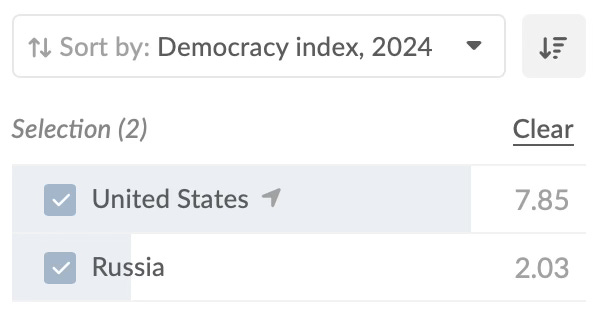
If these infractions qualify Russia (at the time the text was written) as a borderline authoritarian government, then we need a more serious look into the American government as it stands today. On the 2024 Democracy Index—relying on data sourced from the Economist Intelligence Unit—the United States is rated at 7.85 while Russia is rated at a measly 2.03.
In the United States, undemocratic practices are rampant throughout the nation’s politics and government. Rigged trials of opponents, extensive political corruption, and mass censorship, deplatforming, and debanking of dissidents—much like the issues cited in Russia’s analysis—are some of the undemocratic practices that have defined American life for much of the past few decades. In just the past five years alone, there are ample examples that illustrate this: the extensive lawfare by the Democratic Party against their Republican political opponent Donald Trump, the still puzzling story of how the same presidential candidate was almost assassinated on live television, the coordinated attempt to stifle the Hunter Biden laptop story by the New York Post to prevent Biden’s presidential campaign from facing ruinous scrutiny, the years-long Russiagate hoax promulgated by government insiders, politicians, and officials, now finally being exposed for what it truly was by the current administration, the backdoor collaboration of government agencies with Big Tech corporations that formed the newly established censorship apparatus that wiped off dissidents from digital platforms such as Twitter, Facebook, and Youtube, as revealed by Matt Taibbi’s Twitter Files, the current Trump administration’s use of deportation as a tactic to censor and remove lawful permanent residents whose activism stand in opposition to the administration’s interests, and so, so many more.
In the same token, American elections are known to be fierce and competitive, but they have rarely ever been fair. What exactly do we mean by fair elections if the will of the people is always thwarted by the dominant establishment two-party system, and new third parties are routinely sidelined? Outside of the clear concerns about the issue of election rigging (voiced by both political parties at different points), there is no better example of the lack of fair elections in American politics than what happened to Bernie Sander’s unprecedented movement and campaign in 2016 and 2020, and Robert F. Kennedy Jr.’s 2024 Democratic presidential campaign—both strategically sidelined and ousted by the Democratic National Committee.
Fair elections are impossible if the final candidates that voters are allowed to vote for are advanced to the debate stage, and ultimately to office, by lofty funding networks with interests directly opposed to that of the electorate. As Boss Tweed, a 19th-century American politician most notable for being the political boss of Tammany Hall, suggests, “I don’t care who does the electing, as long as I get to do the nominating.” It’s more about creating the illusion of a democratic society than actually providing one; that is no different from an outright authoritarian state—the outcome is inevitably the same: the subjugation of citizens for the interests of the elites in power.
In the Meaning of Democracy, significant restrictions of print media and a tightly controlled news is cited as one of the reasons that disqualifies Russia from being categorized as a consolidated government. However a quick look at America’s print and corporate news media reveals just how tightly controlled legacy media is in the United States. Stateside propaganda is of the highest order that those who are routinely propagandized do not even know that they are, and those who are mouthpieces for the establishment in news media believe themselves to be doing real journalism rather than serving as a state-backed stenographer. Across corporate news media platforms and publications, narratives exist in lockstep no matter the issue. Until one engages with independent media outlets (which routinely face constant censorship pressures from the establishment), honest and nonpartisan analysis of world news will rarely be encountered.
Noam Chomsky highlighted this issue of how American media is tightly controlled many years ago in his acclaimed book Manufacturing Consent, which illustrates the mechanisms by which publications and news shows filter world events through the establishment’s ideological and political lens. A Gallup poll from 2024 revealed that Americans’ trust in the news media is at a new record low. Reportedly only 31% of Americans still have trust in the news media, a nearly ten percent drop from a decade ago. Perhaps no better example depicts this than the recent news of PBS and NPR losing their funding, and rightfully so. As independent journalist Matt Taibbi puts it:
[PBS and the Corporation for Public Broadcasting] should have run forever. National Public Radio ruined the enterprise, turning the country’s signature public news shows into an endless partisan therapy session, a Nine Perfect Strangers retreat for high-income audiences micro-dosing on Marx and Kendi.
There are plenty more cases that could be made against the United State’s so-called democratic government. But the point remains: of the seven democratic principles, the United States arguably fails on the first five. While the extent of the failures can be debated, it is unquestionable that the American government as it stands requires more objective scrutiny as it slides ever so closely toward an authoritarian government. And that’s no hyperbole as we collectively saw a preview of this during the COVID-19 era that locked citizens down, restricted access of unvaccinated citizens to essential needs and ability to work, and censored critical voices in medicine and in the intellectual arena who were challenging the narrative and solutions put forth by the government and pharmaceutical companies.
The United States once had genuinely democratic governance structures, however imperfect and limited, fundamentally based around decentralized and publicly accessible mass-member parties. The Democratic Party, as a small "d" democratic institution, and the Republican Party, as a small "r" republican institution, were honest in their naming and functioned within a politically, economically, governmentally, financially, and scientifically decentralized system with legal/regulatory variability, policy variability, and institutional plurality. These parties, while far from flawless, allowed for real representation, genuinely participatory governance structures even for very serious policy matters with real participation, and a level of public accountability in political, economic, governmental, financial, and scientific decision making.
However, after WW2 a long multi decadal transformation began due to the dirty deeds of a convergence of several interests and an assortment of powerful special interest groups, and then our parties were transformed into centralized, exclusionary membership organizations. The so called Democratic Party has become a technocracy party, and the so called Republican Party became a conservative party. Neither really represents their original principles of democracy or republicanism, and they dont offer meaningful access or representation to the public. This transformation of the parties has been accompanied by a broader centralization of political, economic, and scientific decision making, which has caused the effective loss of most democratic governance structures.